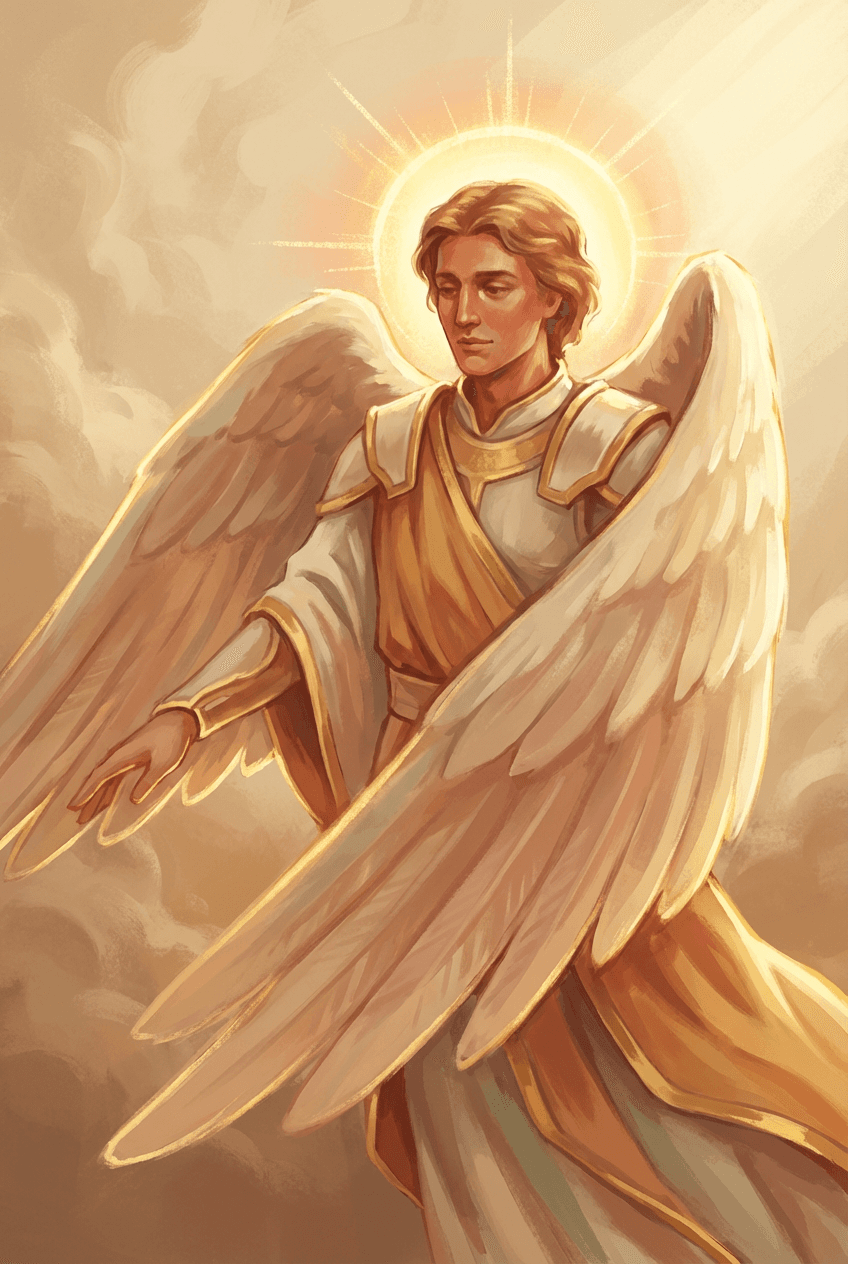
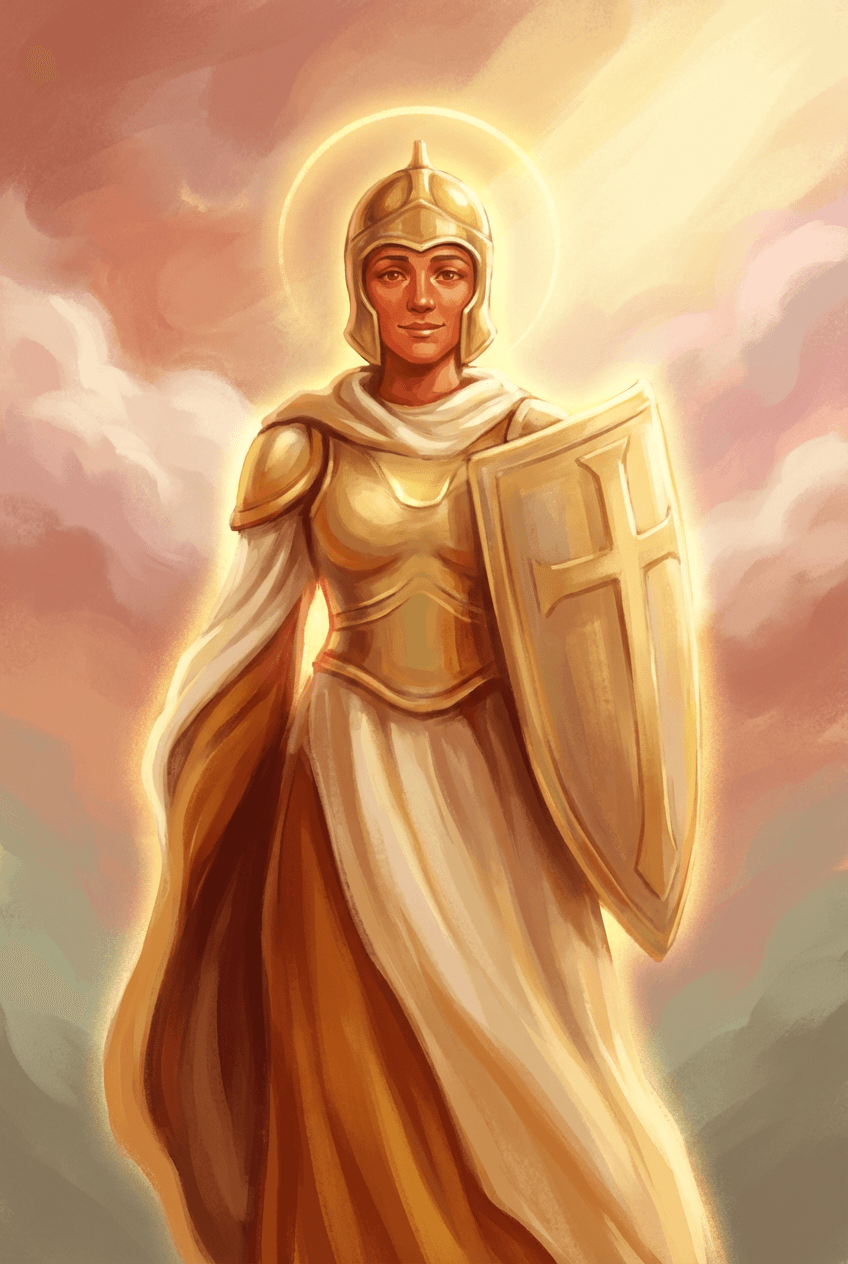
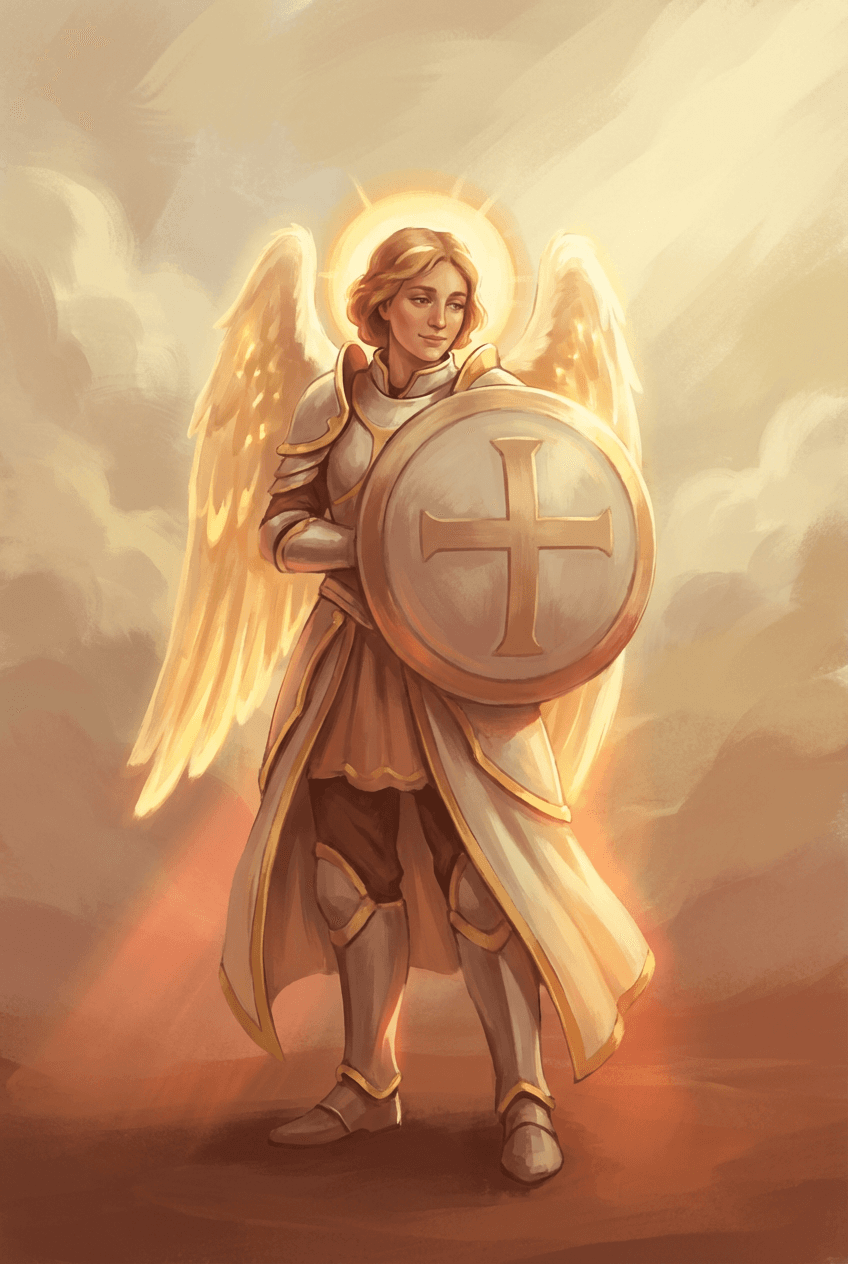
Saint Michael the Archangel,
defend us in battle.
Be our protection against the wickedness
and snares of the devil.
May God rebuke him, we humbly pray,
and do thou, O Prince of the heavenly hosts,
by the power of God,
cast into hell Satan,
and all the evil spirits,
who prowl about the world
seeking the ruin of souls.
Amen.
Most glorious Prince of the Heavenly Armies, Saint Michael the Archangel, defend us in our battle against principalities and powers, against the rulers of this world of darkness, against the spirits of wickedness in the high places.
Come to the assistance of men whom God has created to His likeness and whom He has redeemed at a great price from the tyranny of the devil.
Holy Church venerates you as her guardian and protector; to you, the Lord has entrusted the souls of the redeemed to be led into heaven. Pray therefore the God of Peace to crush Satan beneath our feet, that he may no longer retain men captive and do injury to the Church.
Offer our prayers to the Most High, that without delay they may draw His mercy down upon us; take hold of the dragon, the old serpent, which is the devil and Satan, bind him and cast him into the bottomless pit so that he may no longer seduce the nations. Amen.
O God, the Father of our Lord Jesus Christ, we call upon Your holy Name, and humbly implore Your clemency, that by the intercession of Mary, ever Virgin Immaculate and our Mother, and of the glorious Archangel Saint Michael, You would deign to help us against Satan and all the other unclean spirits who wander about the world for the injury of the human race and the ruin of souls. Amen.
Spiritual Warfare Prayers
The prayers the Church actually gives her people for the unseen battle — and the way she means them to be prayed.
From the Church’s tradition: Every prayer here is deprecatory: it asks God to act, never commands the enemy directly. That is the Church’s pattern for the laity (Jude 1:9 — "the Lord command thee"), and it is the difference between Catholic spiritual warfare and everything that imitates it.
Search "spiritual warfare prayers" and the internet will hand you scripts for commanding demons, binding spirits, and declaring authority over the powers of darkness. The Catholic tradition is both older and steadier than that. It has fought this war for two thousand years, and it has learned to fight it on its knees.
What follows is the actual arsenal the Church puts in a layperson’s hands: the St. Michael Prayer, the armor of God, a profession of trust before the Lord. None of them squares up to the devil to give him orders. Each turns to God and asks. That restraint is not weakness — it is the whole secret. The saints who frightened hell most were the humblest, because their strength was never their own.
Listen — The Armor of God, narrated
The St. Michael Prayer
Leo XIII’s prayer to the prince of the heavenly host — the Church’s front-line petition. Notice its grammar: "may God rebuke him." Even the archangel asks.
The Armor of God
Praying on the armor St. Paul describes in Ephesians 6 — truth, righteousness, faith, salvation, and the word of God.
Heavenly Father, I put on the full armor of God, that I may be able to stand against the schemes of the devil. For my struggle is not against flesh and blood, but against the rulers, against the authorities, against the powers of this dark world and against the spiritual forces of evil in the heavenly realms.
I PUT ON THE BELT OF TRUTH:
Lord, gird me with Your truth. Expose every lie of the enemy. Let me walk in honesty and integrity. Your Word is truth, and the truth sets me free.
I PUT ON THE BREASTPLATE OF RIGHTEOUSNESS:
Lord, guard my heart with Your righteousness. Not my own, but the righteousness of Christ that covers me. Protect my emotions, my desires, and my will from the arrows of the enemy.
I PUT ON THE SHOES OF THE GOSPEL OF PEACE:
Lord, let me walk in Your peace today. Wherever my feet tread, let Your kingdom come. Give me readiness to share the Gospel and to bring Your peace to every situation.
I TAKE UP THE SHIELD OF FAITH:
Lord, strengthen my faith. With it I extinguish all the flaming arrows of the evil one — every doubt, every fear, every temptation, every lie. I trust in You completely.
I PUT ON THE HELMET OF SALVATION:
Lord, protect my mind. Guard my thoughts. Let me think only on what is true, noble, right, pure, lovely, and admirable. I reject every intrusive thought from the enemy.
I TAKE UP THE SWORD OF THE SPIRIT:
Lord, Your Word is my weapon. It is living and active, sharper than any double-edged sword. I stand on Your promises and declare Your truth over my life.
Father, with this full armor I take my stand. I am strong in You and in Your mighty power. No weapon formed against me shall prosper. Through Christ who strengthens me, I am more than a conqueror. Amen.
— Based on Ephesians 6:10-18
Standing Firm: A Profession of Trust
Not a declaration hurled at the enemy, but a profession made before God — the ground a Christian actually stands on.
Lord God, before I face another hour of this battle, let me first remember who You are. My confidence is not in my own strength but in Yours, and so I make my profession to You.
"Finally, be strong in the Lord and in the strength of his might. Put on the whole armor of God, that you may be able to stand against the wiles of the devil." — Ephesians 6:10-11 (WEBC)
YOU ARE MY ROCK:
Father, You are eternal, unchanging, and faithful. You laid the foundations of the earth, and not one of Your promises has ever failed. I stand on You, and the ground will not give way beneath me.
YOU ARE MY VICTORY:
Jesus, by Your Cross and Resurrection You have already overcome the world. On Calvary You stripped the enemy of his power and triumphed over him in the open. I do not fight to win a victory of my own — I shelter in the victory You have already won, and I unite my struggles to Your Cross.
YOU ARE MY STRENGTH WITHIN:
Holy Spirit, You dwell in me as in a temple. You are greater than any power that rises against me, and Your light scatters every shadow. I trust You to guard what I cannot guard myself.
So now, Lord, clothe me for the day. Gird me with the belt of Your truth and cover my heart with the breastplate of Your justice. Steady my steps in the Gospel of peace, and let the shield of faith quench every flaming arrow of the evil one. Set the helmet of salvation upon my mind, and place in my hand the sword of the Spirit, which is the word of God.
Saint Michael the Archangel, defend us in battle; be our protection against the wickedness and snares of the devil. May God rebuke him, we humbly pray; and do thou, O Prince of the heavenly host, by the power of God, cast into hell Satan and all the evil spirits who prowl about the world seeking the ruin of souls.
Lord, when lying thoughts and fear press in on me, whatever their source, I bring them to You and ask You to scatter them with Your truth. By Your grace I refuse to give way to despair, and I cling to the hope that is in Christ. I belong to Jesus, body and soul, now and forever.
The battle is the Lord's, and I will stand firm in Him. Amen.
Keep this prayer with you
Share the St. Michael the Archangel card
A prayer card you can send to someone who needs it tonight, save to your phone, or print for your wall.
Free. The app reads it aloud with you, every day.
How the Church fights
The Church’s spiritual warfare has an order, and the order is the message. First comes the state of grace — confession and the Eucharist do more against the enemy than any special prayer, because the surest defense is a soul united to God. The desert fathers, the great spiritual masters, and every serious Catholic treatment of the subject begin here, not with technique.
Then come the prayers of petition — and notice their grammar. The St. Michael Prayer asks God to rebuke the enemy. The armor of God is received, not manufactured. Psalm 91 takes shelter. Not one of them addresses the devil directly or claims authority over him. Scripture itself draws the line: when the archangel Michael contended with the devil, "he durst not bring against him the judgment of railing speech, but said: The Lord command thee" (Jude 1:9). If Michael speaks that carefully, so may we.
This is what separates Catholic spiritual warfare from the deliverance-culture imitations of it. Commanding spirits, binding and loosing, declaring authority — these belong, where they belong at all, to the Church’s ordained and authorized ministry, never to private prayer. For the layperson the path is humbler and unbreakable: a soul in grace, the prayers of petition, and a priest when the matter is serious. Hell has never found a way around it.
When to pray it
- ✦Daily, as a rule of protection — the St. Michael Prayer and a decade of the Rosary are the classic minimum.
- ✦In the morning, putting on the armor of God before the day’s battles.
- ✦Whenever temptation, fear, or oppression presses harder than usual.
- ✦Always from a soul in the state of grace — confession soon, Eucharist often.
The front-line prayers
Standing firm

Questions about St. Michael the Archangel
What are the most powerful spiritual warfare prayers?+
The Church does not rank prayers by power — and wariness of that very question is part of her wisdom. Her front line for the laity is the St. Michael Prayer, Psalm 91, the Rosary, and the Jesus Prayer, all prayed from a soul in the state of grace. A simple prayer offered in grace outweighs any elaborate formula, because the strength is God’s and not the words’.
Should spiritual warfare prayers command or bind demons?+
Not in the mouth of a layperson. The Catholic pattern is deprecatory — asking God to act — not imperative prayer that addresses or commands spirits directly. Even St. Michael, in Scripture, says "the Lord command thee" (Jude 1:9). Commanding spirits belongs to the Church’s authorized ministry, never to private devotion; reaching for it on your own is one of the doors the enemy is happy to hold open.
What is the Catholic alternative to "binding and loosing" prayers?+
Petition. Instead of "I bind you," the Church prays "St. Michael, defend us… may God rebuke him." Instead of declaring authority, she takes shelter (Psalm 91) and asks for mercy (the Jesus Prayer). The prayers on this page are that alternative — every one of them addressed to God, none to the enemy.
When should I involve a priest?+
Earlier than most people do. Any spiritual pressure that persists despite prayer and the sacraments, that frightens you or your household, or that involves things you cannot explain belongs in a conversation with your parish priest. And remember that much heaviness is simply human — exhaustion, anxiety, grief — and deserves real care, medical and psychological, without any shame; the Church discerns the two together, never against each other. Discernment and the Church’s reserved ministries exist for exactly the serious cases, and going to them early is what trusting the Church looks like.
Did this prayer help you today?
If it did, consider supporting Brother Michael's work directly — your gift helps sponsor access for people who can't afford a plan and keeps new prayers + reflections coming.
Separate from your subscription — every gift goes to the ministry.